Mack O'reilly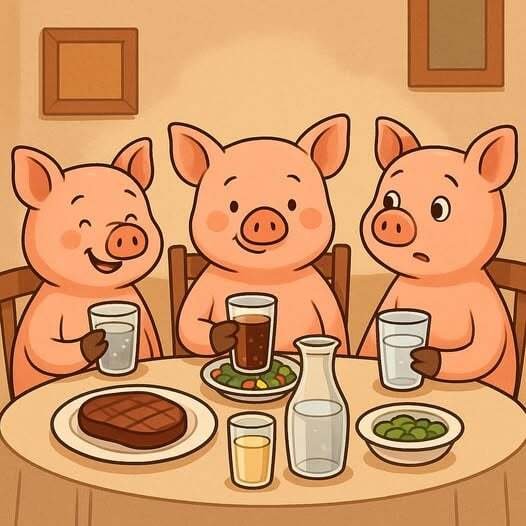
Some jokes survive because they are clever. Others survive because they are familiar. And every now and then, one lasts because it manages to be both.
Stories about pigs belong to that strange category of humor that feels childish on the surface but oddly durable underneath. They arrive dressed like nursery material, harmless and silly, yet often carry just enough wit to keep adults listening. A joke about pigs at dinner should not, in theory, hold much weight. But somehow it does.
That is partly because pig stories have always been more human than animal. They exaggerate appetite, stubbornness, confusion, vanity, or absurd logic in ways people instantly recognize. The animals are only a disguise. The real subject is us. The source article leans into exactly that tradition, framing pig humor as a reflection of human quirks, social contradiction, and comic wordplay rather than mere nonsense.
And that may be why even a throwaway joke can feel surprisingly well built when it lands.
A Dinner Table, Three Drinks, and One Familiar Phrase
The first story in the source is simple enough to sound almost too thin to work. Three little pigs go out to dinner. One orders soda, another orders cola, and the third keeps asking for glass after glass of water. The setup is repetitive in the way many old jokes are, building rhythm rather than suspense. Then comes the question from the waiter: why all the water? The answer turns a childhood phrase into the punchline. The pig wants to “wee-wee-wee all the way home.”
The line works because it depends on recognition.
A familiar nursery image is broken open and reassembled through bodily logic. Suddenly a phrase people know by sound becomes funny by function. It is not sophisticated in the grand literary sense, but it is structurally neat. The joke rewards memory. It asks the listener to hold two meanings in the mind at once, then enjoy the moment when they collide.
That collision is the engine of most enduring humor. A sentence is heard one way for years, then twisted just enough to reveal another meaning that had been hiding in plain sight.
The Real Skill Behind “Silly” Humor
What makes old-fashioned joke writing harder than it looks is that silliness must still be precise.
The pig joke in the article is brief, but it understands tempo. It starts with an ordinary social scene, adds a repeated detail, waits for curiosity to form, and then resolves the pattern with a payoff that is both childish and exact. The joke does not over-explain itself. It trusts that the listener knows the rhyme and will complete the leap.
That trust matters.
Humor often gets weaker when it explains too much. A good joke leaves just enough space for the audience to participate. In this case, the audience does part of the work by remembering the original phrase and feeling the twist click into place. The article highlights this as a playful reinterpretation of a familiar line, and that description is accurate: the humor comes not from inventing something entirely new, but from rerouting something already stored in the mind.
In that sense, the joke is almost architectural. It depends on structure more than spectacle.
The Second Joke Is Doing Something Different
The article then shifts to another pig-centered story, this time involving a farmer who keeps getting fined over how he feeds his pigs. First he is punished for giving them scraps. Then, after upgrading their meals to something lavish, he is punished again for excess. Eventually he solves the problem by giving the pigs money to choose their own food.
This joke operates in a different register.
The first one is pure wordplay. The second is satire. Instead of hinging on a pun, it builds around contradiction. The farmer cannot satisfy the system because the standards themselves are unstable. No matter what he does, authority finds a reason to object. The absurdity is the point.
And that is where the humor becomes more adult. Beneath the farmyard framing is a familiar social frustration: being trapped between rules that conflict, interpretations that change, and expectations that seem impossible to meet all at once. The article explicitly describes the farmer as a stand-in for anyone navigating bureaucracy without a clear path to compliance.
That is a much more recognizable feeling than the joke’s surface might suggest.
Why Animal Humor Ages So Gracefully
There is a reason human flaws keep being outsourced to animals in comedy.
Animals create distance. They allow exaggeration without direct accusation. A pig can be greedy, foolish, pampered, dramatic, or weirdly logical without triggering the same defensiveness a human character might. The listener lowers their guard. That makes the joke easier to absorb, even when its target is unmistakably human behavior.
The article’s introduction makes this point clearly by presenting pigs as long-standing mirrors of human habits, contradictions, and excesses. That framing explains why the humor feels timeless even when the setup is old. The pig is not just an animal in the story. It is a safe container for human absurdity.
Fairy tales understood this. Folklore understood this. Political cartoons understand it too. Comedy often works best when it can tilt reality slightly sideways rather than confronting it head-on.
And pigs, for whatever reason, are unusually good at carrying that burden.
The Quiet Intelligence of Familiar Forms
There is also something worth noticing about the article’s larger shape. It does not treat these jokes as random fragments. It presents them as examples of how humor can do two things at once: entertain through language and expose social absurdity through exaggeration. That is a smarter reading than people often give lightweight content.
Too much modern commentary draws a harsh line between “serious” writing and “just jokes,” as if humor has no interpretive value. But jokes are often compressed essays. They reduce conflict to a pattern and deliver judgment in a form quick enough to bypass resistance. A punchline can say, in one sentence, what a longer argument would need a page to explain.
The pigs at dinner joke says language is slippery.
The farmer joke says institutions can be ridiculous.
Neither point is profound on its own. But each becomes memorable because it is attached to a comic image.
That is not trivial. That is efficient.
Why People Still Share These Stories
Part of the answer is simple: they are easy to retell.
A good short joke travels well because it does not require background knowledge, emotional investment, or deep concentration. It can be dropped into conversation, passed through family, posted online, or repeated from memory. But ease alone does not explain longevity. Plenty of easy jokes disappear.
The ones that remain usually carry a second layer, even a faint one. Something about them feels reusable because they are not locked to one moment. The pig at dinner joke can survive because childhood rhyme is durable. The farmer joke can survive because bureaucratic frustration never really goes out of style.
That is what gives these stories a kind of light resilience. They are simple enough to be casual, but not so empty that they evaporate immediately after being heard.
And maybe that balance is harder to achieve than it seems.
More Than a Joke, Less Than a Lecture
What the article ultimately understands is that humor does not need to be grand to be effective. These pig stories are not trying to become moral philosophy. They are not pretending to be profound revelations. They simply use familiar characters and comic exaggeration to point at recognizable truths: people are illogical, systems are inconsistent, and language is full of openings for playful mischief.
That modesty is part of their charm.
Not every piece of writing needs to transform the reader. Sometimes it only needs to offer a quick burst of recognition. A smile. A groan. A moment of appreciating how neatly a silly premise was put together. The best light humor respects that small function instead of trying to become more important than it is.
And yet, like many durable jokes, these stories end up doing a little more than they promise.
They remind us that nonsense often works because it is built on something true. A pig wanting too much water, a farmer punished no matter what he does, a nursery phrase turned inside out — all of it is absurd, but none of it is meaningless.
That is why these jokes still hold.
They are small comic mirrors, and people keep recognizing themselves in them.