Mack O'reilly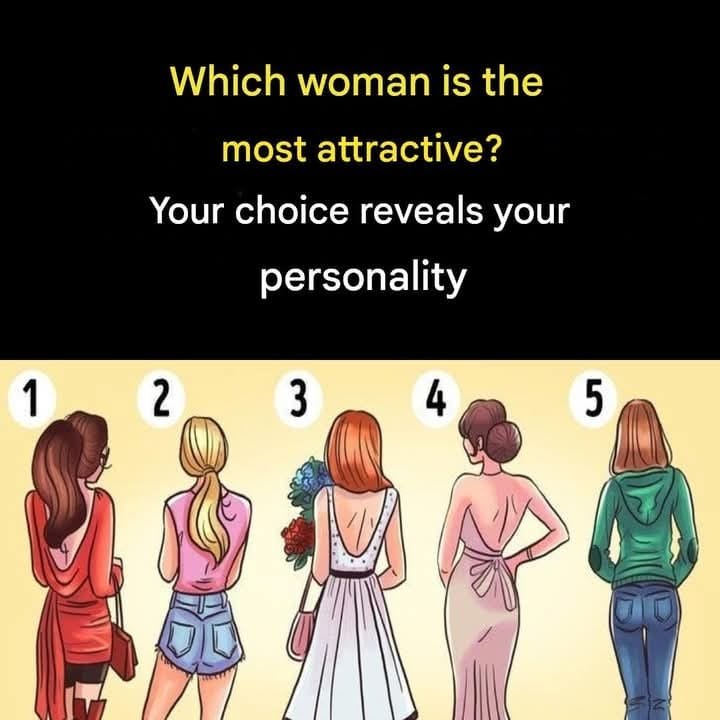
At first glance, it looks like a simple image.
Several women stand side by side, each facing away. Their hair, posture, and clothing differ slightly, but their faces remain hidden. The question is straightforward:
Which woman do you think will be the most attractive when she turns around?
Many people instinctively choose one almost immediately. Others pause, studying details before making a decision. What seems like a playful visual puzzle has quickly become a viral personality challenge across social media.
But what makes these types of images so fascinating isn’t just the mystery. It’s the idea that your choice might reflect something about how you think, what you notice, and how you form impressions.
Why Visual Personality Puzzles Go Viral
Images like this spread rapidly online because they combine curiosity and self-reflection. The puzzle itself is simple, yet the interpretation invites viewers to learn something about themselves.
When someone shares the image with friends, the discussion quickly follows:
- “Why did you pick that one?”
- “What does my choice mean?”
- “I almost chose that one too.”
These conversations make the puzzle interactive. Instead of simply viewing an image, people become part of a shared guessing game.
Psychologists often point out that humans naturally try to interpret incomplete information. When faces or details are hidden, the mind fills the gap using subtle cues like posture, hairstyle, and body language.
What Your First Impression Says
One interesting aspect of this puzzle is how quickly many people decide.
First impressions often happen within seconds. The brain processes visual information rapidly, forming judgments based on patterns it recognizes from past experiences.
For example, someone might choose a figure because:
- The hairstyle seems familiar
- The posture feels confident
- The clothing style matches personal preferences
- The figure stands out from the others
Even if we aren’t aware of it, these small signals influence our perception.
The Psychology of Projection
When people select a specific figure, they often believe they are predicting what the person will look like. In reality, they may be revealing something about themselves.
Psychologists call this projection — the tendency to interpret ambiguous situations through our own beliefs, preferences, or expectations.
For instance:
- Someone drawn to bold posture may value confidence.
- Someone focused on subtle details may be more analytical.
- Someone who chooses quickly may rely strongly on intuition.
This doesn’t mean the puzzle can diagnose personality traits with scientific accuracy. Instead, it acts as a mirror reflecting how we approach uncertainty.
Why Hidden Faces Spark Curiosity
Humans are naturally wired to recognize faces. From infancy, the brain prioritizes facial recognition as a way to understand emotion and communication.
When faces are hidden, curiosity intensifies.
The mind begins imagining possibilities:
- What expression might appear?
- What features might be revealed?
- Will expectations match reality?
This uncertainty keeps people engaged far longer than a typical image would.
The Social Element of the Challenge
Another reason these puzzles spread so quickly is that they encourage comparison.
People rarely keep their choice private. Instead, they ask friends and family to participate.
Suddenly the puzzle becomes a group activity.
Some people agree on the same figure. Others strongly disagree. The debate itself becomes part of the entertainment.
These moments create exactly the kind of engagement social media algorithms favor.
Why the Answer Is Less Important Than the Choice
Interestingly, the real “reveal” in many of these puzzles isn’t about which woman is objectively the most attractive.
Beauty is subjective, influenced by culture, experience, and personal preference.
What matters more is why someone felt drawn to one particular figure in the first place.
That small moment of decision says something about how the brain processes incomplete information.
The Appeal of Simple Mysteries
In a world full of complex information, puzzles like this offer a refreshing kind of curiosity.
They don’t require long explanations or complicated rules. A single image and one simple question are enough to spark imagination.
People enjoy testing their intuition and comparing their answers with others.
Sometimes the most engaging challenges are also the simplest.
A Reminder About Perception
Visual puzzles highlight something important about perception: we often think we see the world objectively, but our interpretation is shaped by personal experience.
Two people looking at the same image may notice completely different details.
One might focus on posture.
Another might notice clothing style.
A third might simply choose the figure that stands out the most.
None of these approaches are right or wrong. They simply reflect different ways of seeing.
The Real Fun of the Puzzle
Whether someone chooses the first figure or the last, the real enjoyment comes from the process itself.
Looking closely.
Trusting instinct.
Comparing answers.
And of course, imagining what might happen when each person finally turns around.
Because sometimes the most interesting part of a puzzle isn’t the answer — it’s the moment of curiosity that leads you there.