Mack O'reilly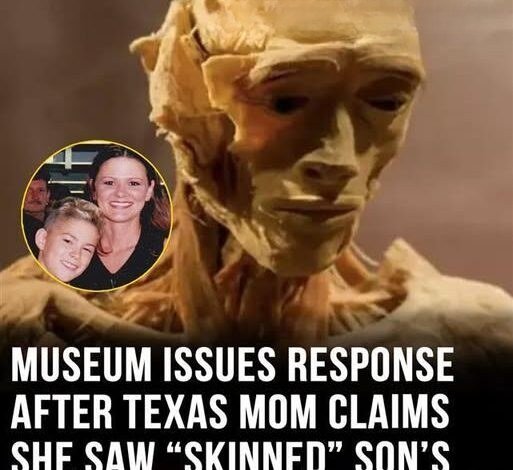
Some stories spread because they are unusual.
Others spread because they touch a deeper nerve.
This one did both.
A headline began circulating online claiming that a mother believed she had recognized her son’s body in a public anatomy exhibit. The language was shocking, emotional, and almost impossible to ignore. Whether people clicked out of disbelief, curiosity, or horror, the story landed in exactly the place where public fascination and public discomfort meet.
What made it resonate so strongly was not only the claim itself.
It was what the claim suggested about trust, dignity, and the uneasy boundary between education and spectacle.
Why Anatomy Exhibits Provoke Such Strong Reactions
For years, anatomy exhibitions have attracted large audiences by showing the inner structure of the human body in ways most people never see.
Supporters often describe them as educational. They argue that these displays help visitors understand the body more clearly than textbooks or diagrams ever could. Muscles, tendons, organs, and skeletal structures become immediate and real.
But even at their most respected, exhibits like these ask the public to accept something difficult:
that human remains—or preserved bodies—can be displayed in a museum setting for learning, reflection, or public interest.
That acceptance is never completely comfortable.
And when a story appears suggesting that a displayed body may not have been handled with the transparency or dignity people expect, that discomfort becomes something much bigger.
The Emotional Force of Recognition
Part of what makes the reported claim so unsettling is the emotional image at its center: a parent walking through a public exhibit and suddenly feeling certain that one of the bodies on display belongs to someone they lost.
Whether that recognition is accurate, mistaken, or impossible to verify in the moment, the idea is powerful enough to stop people cold.
It taps into something primal.
The body of a loved one is not just biological matter. It carries memory, grief, identity, and family connection. To imagine that body appearing in a museum without clear consent or full understanding is to imagine a profound violation—not only of privacy, but of mourning itself.
That is why the story traveled so fast.
Not because museum policy is usually headline news, but because this specific claim turned policy into something painfully human.
Museums Depend on Trust More Than Most People Realize
Public institutions often rely on a quiet assumption: that the people who run them have done the ethical work long before visitors arrive.
Most visitors don’t ask for source documentation when they look at a display case. They trust that the museum has handled acquisition, consent, verification, and legal compliance properly.
That trust is especially important when the subject is the human body.
If a museum is showing anatomical material, people assume that:
- the remains were obtained lawfully
- there was appropriate consent
- identities were handled responsibly
- ethical guidelines were followed
When even one story appears to challenge that assumption, the entire structure of public confidence can feel less stable.
Why the Public Always Reacts More Strongly to Human Stories Than Institutional Statements
Institutional responses are usually careful.
They emphasize procedure, policy, and review. They speak in a language meant to reassure: documentation was followed, protocols exist, the matter is being examined, the institution takes concerns seriously.
But emotional stories don’t move through the world in procedural language.
They move through images.
A grieving mother.
A shocking recognition.
A public display.
A question with no easy answer.
That imbalance matters.
No matter how measured an institutional statement may be, it often struggles to compete with the emotional force of a personal claim. The public does not process those two things equally. One feels formal. The other feels immediate.
And in stories like this, immediate feeling tends to travel faster.
The Uneasy History Behind Public Displays of the Human Body
There is also a larger context that makes people react strongly to these stories.
Displays of human remains have a complicated history. Across different eras and institutions, museums, universities, and collectors have not always treated human bodies with the standards that modern audiences would now expect. That history leaves a residue of suspicion.
So when a new controversy appears, people do not encounter it as an isolated incident.
They encounter it against a background of older questions:
Who consented?
Who had the power to decide?
Who benefits from the display?
Who gets to define “educational”?
Those questions are not answered by one headline, but they are activated by it.
Why This Story Is Really About Dignity
At its core, this is not only a museum story.
It is a dignity story.
The real reason people care is not merely whether one display was properly sourced or one institution followed the correct process. It is whether society still understands that the dead deserve care, and that the families of the dead deserve clarity.
Museums may frame anatomy exhibits around science.
Visitors may approach them with curiosity.
But when something goes wrong—or even appears to have gone wrong—the issue becomes moral before it becomes technical.
People want to know that the human body is not being reduced to an object just because it can be preserved and displayed.
The Fragile Balance Between Education and Consent
There is no doubt that anatomy can be taught powerfully through real physical displays.
But educational value alone is not enough.
Public acceptance depends on a balance:
- knowledge must be paired with consent
- transparency must support display
- respect must outlive curiosity
The moment that balance seems threatened, the educational frame begins to weaken. What once looked like science starts to look like intrusion. What once looked like public learning starts to feel uncomfortably close to public consumption.
That is the danger institutions face in cases like this—not only a factual dispute, but a collapse in how the public interprets the display itself.
Why Stories Like This Stay With People
Most headlines disappear quickly.
This kind does not.
It lingers because it attaches itself to questions people cannot shake off easily. What happens to the body after death? Who decides where it goes? Can institutions always be trusted to manage that process ethically? What would it feel like to believe you had recognized someone you loved?
Even if readers never visit such an exhibit, the story stays with them because it presses on fears that are universal:
fear of losing control,
fear of not knowing,
fear that memory and body might become separated in ways no family ever intended.
A Story Bigger Than the Headline
Whatever the ultimate facts may be in any one case, the reason this story matters is clear.
It reminds people that institutions dealing with human remains do not operate on curiosity alone. They operate on ethics, trust, and public confidence. If any one of those weakens, the consequences reach far beyond a single exhibit.
Because once the human body enters public display, the question is no longer just what people are learning.
It is whether they still believe the learning is built on respect.
And that, more than anything else, is why a story like this echoes long after the headline fades.