Mack O'reilly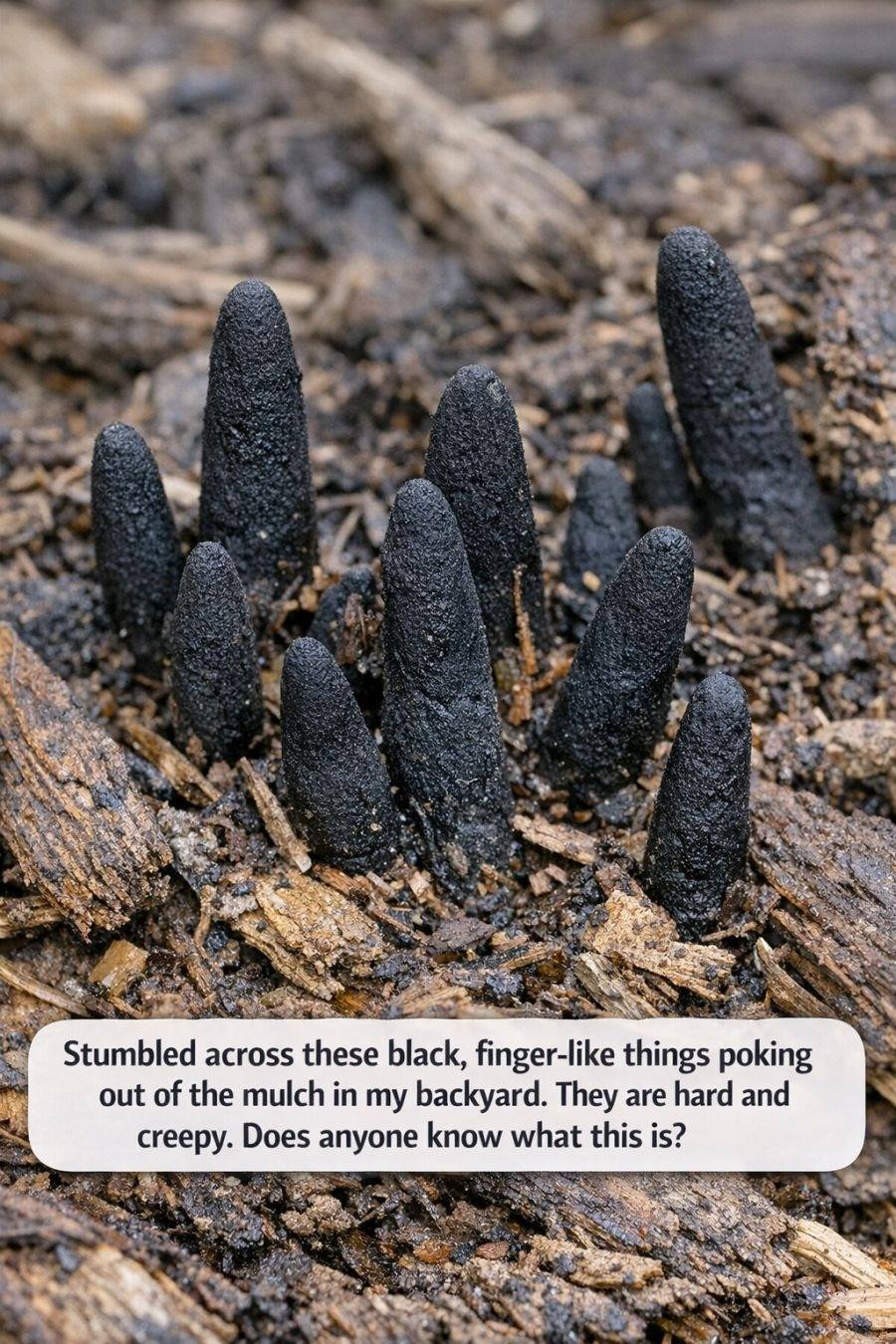
The first reaction is almost always the same.
You look down at the garden bed, notice a cluster of dark shapes pushing up through the mulch, and for a second your brain refuses to file them under anything normal. They do not look like flowers. They do not look like mushrooms in the way most people imagine mushrooms. They look closer to something unearthed than something grown — hard, black, finger-like, as if the ground itself is trying to make a bad impression.
That emotional reaction is exactly why discoveries like this spread so easily online. Backyard mysteries trigger a mix of disgust, fascination, and low-level alarm. People want an answer fast, preferably one that confirms they are not dealing with something toxic, invasive, or dangerous.
In this case, the article’s answer is fairly direct: the strange black protrusions are most likely Dead Man’s Fingers, a fungus called Xylaria polymorpha that commonly appears in mulch, decaying wood, and damp garden areas. It looks unsettling, but the article emphasizes that it is generally harmless to people, pets, and plants.
Why This Fungus Looks So Disturbing
Part of what makes Dead Man’s Fingers so memorable is that it seems designed to trigger unease.
According to the source, the growths are typically dark brown to black when mature, elongated, and often about 3 to 4 inches tall. They emerge in clusters and can resemble a small hand of rigid, dark fingers pushing out of the earth. Their hard, woody texture makes them seem even less like ordinary fungi and more like some kind of dried organic structure.
That appearance matters because it explains why people so often misread the situation. Most people associate mushrooms with caps, stems, or soft rounded forms. Dead Man’s Fingers violates that expectation completely. It belongs to the category of fungi that does not look “fungal” to the average homeowner.
And when something in the yard fails to match a familiar pattern, the imagination takes over.
What It Actually Is Doing There
The article identifies the fungus as saprobic, meaning it feeds on decaying organic matter rather than attacking healthy living plants. More specifically, it tends to grow from buried or rotting wood, including decomposing roots, stumps, wood chips, or mulch with a high wood content.
That is the key to understanding the problem correctly.
The fungus is not appearing randomly. It is responding to conditions that already exist. If you find it in a garden bed, the real story is usually below the surface: old wood, woody mulch, moisture, and shade are creating an ideal environment for fungal growth. The fungus is a symptom of decomposition, not a sign that your yard has suddenly become dangerous.
This is an important distinction because people often treat visible fungi like the main issue when they are actually indicators of something hidden. The fruiting bodies are just the visible part of a larger process already underway in the soil or mulch.
Why Mulch Is Often the Perfect Setting
The source explains that mulch and garden beds are common places for Dead Man’s Fingers because they provide exactly what the fungus needs: decomposing wood, retained moisture, and limited sunlight. Seasonal changes, especially in spring and fall, can make those conditions even more favorable.
That explanation holds up because mulch is essentially a managed decomposition zone. It is meant to break down over time, enrich soil, regulate moisture, and protect roots. But those same qualities also make it attractive to fungi.
So when homeowners ask, “Why is this in my mulch?” the answer is not mysterious at all. It is there because mulch is one of the most hospitable places for wood-decaying organisms to do their work.
The fungus may look eerie, but ecologically it is behaving exactly as expected.
The Biggest Concern People Have — and the Source’s Answer
The practical question behind the fear is simple: Is it dangerous?
The article’s answer is reassuring. It says Dead Man’s Fingers is not harmful to humans, pets, or plants through ordinary contact or proximity. It is not considered edible, but its presence alone is not treated as a threat. It also does not parasitize healthy plants, since its role is to break down dead matter rather than attack living tissue.
That point is probably the most useful takeaway for homeowners. The appearance suggests menace, but the ecological role suggests cleanup.
This is a good example of how appearances distort judgment in garden spaces. Many harmless fungi look alarming, while some genuinely problematic conditions can appear almost invisible at first. That is why identification matters more than instinct.
Why It Gets Misidentified So Often
The source notes that Dead Man’s Fingers is often confused with other odd-looking fungi, especially stinkhorns, or even with blackened roots and decaying plant material.
That confusion makes sense for two reasons.
First, the average person does not have a mental catalog of unusual fungi. Most garden knowledge centers on weeds, flowers, shrubs, and common mushrooms. Strange fungal forms fall outside that everyday literacy.
Second, Dead Man’s Fingers changes over time. The article notes that it may begin as a pale or whitish structure before darkening as it matures, which means people can encounter it at different stages and assume they are looking at completely different organisms.
So the identification challenge is not just that it looks weird. It is that it looks weird in multiple stages.
What You Should Actually Do If You Find It
The article takes a fairly calm position here: if you find Dead Man’s Fingers, there is usually no reason to panic. You can leave it in place if you do not mind the look, since it contributes to decomposition and soil ecology. If you dislike the appearance, you can remove the visible fruiting bodies and the decaying wood beneath them to reduce the chance of regrowth.
That recommendation reflects a broader principle in yard care. Not everything strange needs to be treated like an emergency. Sometimes the right response is simply understanding what role the organism is playing and deciding whether you care enough to intervene.
The source also advises wearing gloves during removal and disposing of the growth in compost or yard waste. That is less about extreme danger and more about standard, sensible handling of outdoor organic material.
Can You Stop It From Coming Back?
Only to a point.
The article says prevention mainly comes down to reducing buried or decaying wood, refreshing or turning mulch, improving drainage, and increasing sunlight exposure where possible. It also suggests that alternative mulch materials may discourage fungal return.
That answer is important because it reveals the limitation of cosmetic removal. Pulling out the visible “fingers” may improve the look of the bed, but it will not solve the underlying condition if the decomposing substrate remains in place.
So the real analysis is this: if the fungus keeps returning, the yard is continuing to provide the same food source and moisture conditions. The recurrence is not random. It is evidence that the environment still supports it.
The Better Way to Read a Discovery Like This
What makes backyard fungal finds so interesting is that they sit at the intersection of fear and ecology. Homeowners see something grotesque and interpret it as invasion. But in many cases, what they are seeing is simply decomposition made visible.
That is exactly what this article helps clarify. Dead Man’s Fingers looks dramatic, but its function is ordinary: it is breaking down wood and participating in nutrient cycling. The source even frames the discovery as a chance to grow more curious about fungi rather than more fearful of them.
That may be the strongest part of the piece.
Instead of feeding panic, it reframes the sight as a reminder that a yard is not just decorative space. It is an ecosystem, and ecosystems are full of organisms that do necessary work without caring whether humans find them aesthetically pleasing.
Creepy, Yes. Dangerous, Usually No.
The black finger-like shapes in mulch are unsettling because they seem to belong to horror imagery more than gardening. But once identified, the situation becomes much less dramatic.
The source’s conclusion is straightforward: these growths are most likely Dead Man’s Fingers, a wood-decaying fungus that thrives in damp, woody environments, is usually harmless in normal yard settings, and can be removed if their appearance bothers you.
So the real lesson is not that your yard is hiding something sinister. It is that nature often looks stranger up close than people expect.
And sometimes the creepiest thing in the flower bed turns out to be one of the least threatening.