Mack O'reilly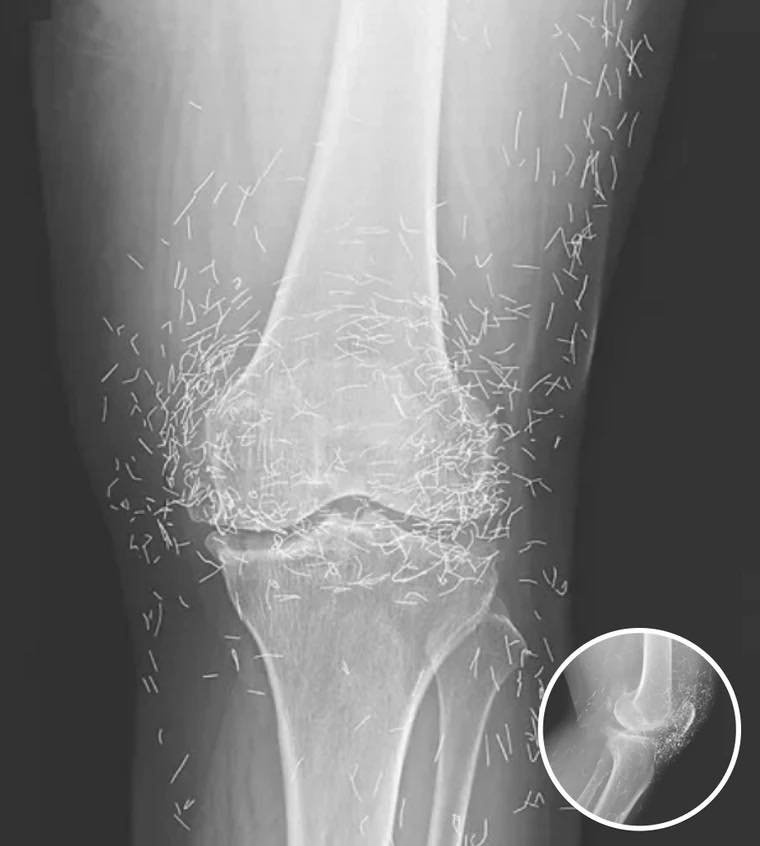
Joint pain often seems predictable at first.
It begins with stiffness, swelling, soreness after movement, or the slow, familiar ache that many people associate with aging and arthritis. Most cases do not come with shocking discoveries. They come with routine explanations: inflamed tissue, worn cartilage, pain management, physical therapy, maybe medication. That is what makes certain medical images so striking — not because they rewrite everything we know, but because they reveal a hidden layer of a problem that had been building quietly for years.
In the case behind this article, a 65-year-old woman with severe knee pain was found to have hundreds of tiny gold threads embedded around her knee joint on X-ray. The threads were linked to prior gold-thread acupuncture, a treatment sometimes used for chronic pain and osteoarthritis. That basic case detail is described both in a 2025 Live Science report and in the original 2013 New England Journal of Medicine case report indexed by PubMed.
What Doctors Actually Saw
The headline leans toward shock, but the underlying medical story is more specific than sensational.
According to the reporting, the woman had long-standing osteoarthritis of the knee, a degenerative condition that can cause pain, stiffness, swelling, and reduced mobility over time. Standard treatments had not fully relieved her symptoms, and she had also experienced gastrointestinal side effects from medication. She then underwent repeated gold-thread acupuncture, in which tiny pieces of gold are left in tissue with the intention of providing ongoing stimulation.
When imaging was done, the X-ray showed not only changes consistent with osteoarthritis but also those numerous metallic threads surrounding the joint. The visual effect is dramatic, which helps explain why the image continues to circulate years later. But medically, the significance is less about surprise and more about what it says regarding treatment choices, evidence, and risk.
Why This Treatment Exists in the First Place
Alternative therapies for chronic pain often become attractive when conventional treatment feels incomplete.
That is part of what makes this case understandable. Osteoarthritis can be stubborn. Pain may fluctuate, medications may cause side effects, and patients often search for solutions that feel more natural, more lasting, or less chemically burdensome. Gold-thread acupuncture is one of those treatments that has appeared in some settings as an adjunctive approach for joint pain, especially in parts of Asia.
The idea behind it is not simply temporary needling. It is the implantation of fine gold material intended to continue stimulating the area over time. That is exactly what makes the X-ray so unusual to outsiders: what looks like an alarming foreign-body finding was, in this case, the residue of a treatment that had been done deliberately.
The Main Concern Is Not Just How It Looks
What makes this case medically important is not merely the visual shock of seeing metal threads in the knee. It is the broader question of whether a treatment offers proven benefit relative to its downside.
Live Science’s summary of the case notes that evidence supporting gold-thread acupuncture is limited, while potential complications can include tissue damage, inflammation, infection, migration of the material, and difficulties with future imaging. The reporting also notes that embedded metal may make MRI unsafe or unsuitable in some circumstances because metallic objects can interact dangerously with magnetic forces.
That shifts the conversation from curiosity to caution.
A striking X-ray is one thing. A treatment that may complicate diagnosis, obscure anatomy, or introduce avoidable risk is another. The image becomes memorable not only because it is odd, but because it captures the long afterlife of a medical decision.
Why Cases Like This Resonate So Strongly
There is something almost symbolic about this kind of story.
Chronic pain often pushes people toward treatments that promise relief when ordinary care feels frustratingly partial. That does not make patients irrational. It makes them human. People in pain are often trying to reclaim control, especially when standard options come with trade-offs of their own. But cases like this reveal the hidden cost of treatments that sound low-risk simply because they fall outside mainstream medicine.
The woman’s X-ray is compelling because it turns that trade-off visible. What had likely been presented as a therapeutic intervention became, years later, a literal pattern of foreign material surrounding a damaged joint.
It is a reminder that “alternative” does not automatically mean harmless, and that the body remembers interventions long after the moment of treatment passes.
A More Useful Reading of the Story
The most productive way to read this case is not as a bizarre one-off meant only to shock readers. It is as a lesson in medical decision-making.
The underlying condition here was osteoarthritis. The embedded gold threads did not erase that diagnosis. Instead, they added another layer to an already difficult problem. The case report and later coverage both frame the finding as a cautionary example of how unconventional pain treatments can leave behind consequences that matter clinically later on.
That matters because stories like this can easily drift into mockery or alarmism. But the more important takeaway is quieter: people dealing with chronic pain deserve treatments that are not only hopeful, but also evidence-based, well-explained, and safe in the long term.
What the X-Ray Really Reveals
At a glance, the image seems to show a medical mystery.
In reality, it reveals something more familiar and more important: the long trail of chronic pain, imperfect solutions, and the risks that can follow when relief is pursued faster than evidence. The woman’s knee pain was real. Her search for treatment was understandable. But the X-ray became a lasting record of how a therapy intended to help can also complicate the picture.
That is why the image still holds attention.
Not because it is merely strange, but because it forces a simple question that sits underneath so much modern health care: when people are desperate for relief, how do they tell the difference between a treatment that truly helps and one that only leaves something behind?