Mack O'reilly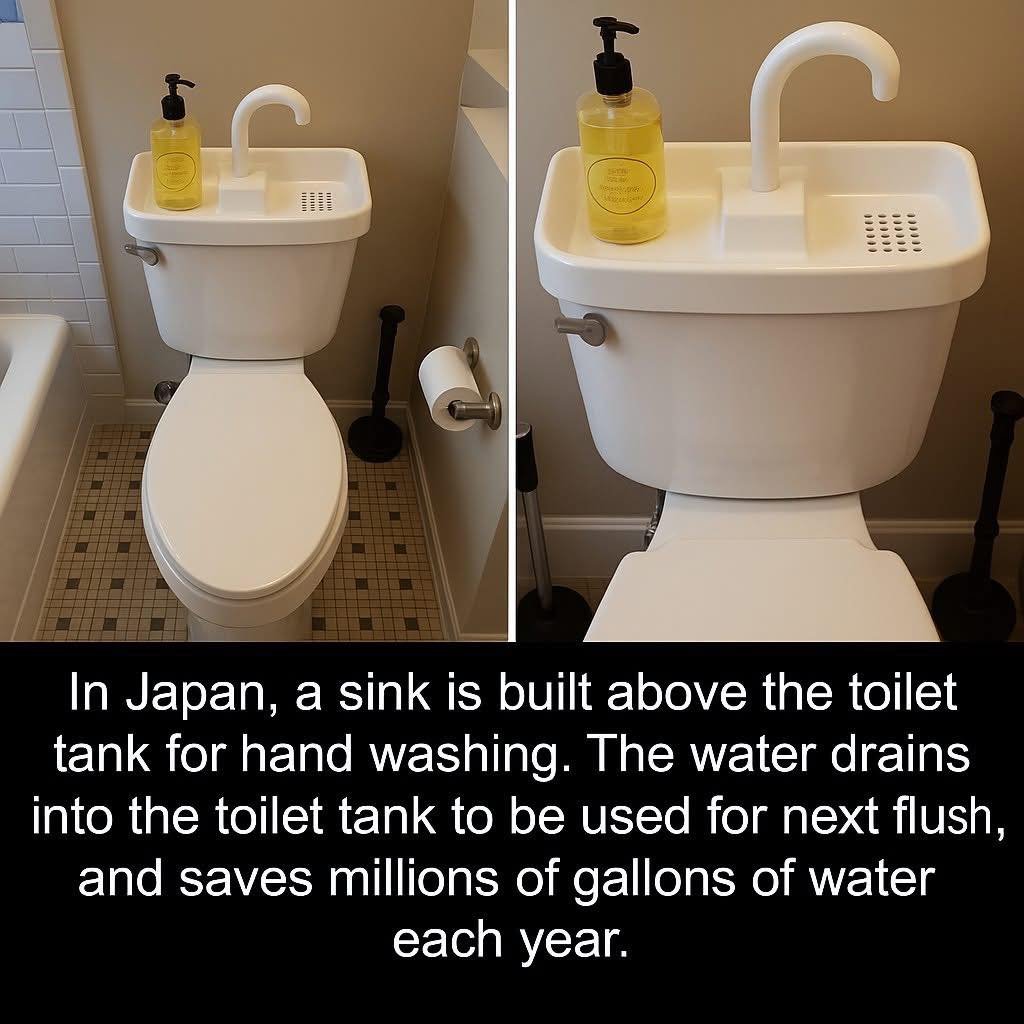
At first glance, it looks confusing.
You walk into a small bathroom, glance at the toilet, and notice something unexpected: a sink built directly above the tank. Not beside it. Not across the room. Right there, as part of the toilet itself.
For anyone seeing it for the first time, the reaction is usually the same:
Wait… is that really a sink?
Yes, it is.
And once you understand how it works, it becomes one of those ideas that feels so smart you start wondering why more places don’t do it.
A Bathroom Design That Feels Surprisingly Logical
In many Japanese homes, especially where space matters and efficiency is valued, toilets with built-in handwashing sinks are a practical solution.
The concept is simple.
After flushing, clean water flows through the small faucet above the tank. You wash your hands there, and that same water is then stored in the tank for the next flush.
Nothing dirty is being reused.
The sink water is fresh tap water first.
Only after handwashing does it move into the tank, where it waits to be used for flushing.
It’s a quiet little system, but an impressively thoughtful one.
Why It Exists in the First Place
The idea reflects a larger design philosophy often associated with Japanese living spaces: make things efficient, clean, and purposeful.
Bathrooms in many urban homes and apartments can be small. Every inch matters. Combining two fixtures into one saves space immediately.
But the design is not just about space.
It’s also about water use.
Instead of using fresh water for handwashing and then separate fresh water again to refill the tank, the system allows one stream of clean water to serve two purposes.
That makes the bathroom feel not only smaller and smarter — but more intentional.
The First Time People See It, They Usually Pause
There is something almost charming about the surprise it creates.
A visitor expects the usual layout: toilet here, sink there.
Instead, they find a compact system that seems to belong in the future and in the past at the same time — futuristic because it’s clever, and old-fashioned because it reflects a kind of practical thinking people admire.
It doesn’t rely on screens, sensors, or flashy gadgets.
It just solves a problem elegantly.
That may be part of why it leaves such an impression.
A Small Feature That Says Something Bigger
What makes this design so interesting is that it reveals how cultural habits shape ordinary objects.
In some countries, bathrooms are built around abundance: more space, more fixtures, more separation between functions.
In others, practicality leads design.
The Japanese toilet-and-sink combination feels like a perfect example of the latter.
It says:
- use what you need
- waste less
- design carefully
- make small spaces work harder
Those values are built into the fixture itself.
Not a Luxury — Just Smart Engineering
What surprises many people most is that the system is not necessarily expensive or elite.
It’s not only found in high-tech showrooms or futuristic hotels.
In many cases, it’s simply part of everyday home design.
That is what makes it memorable.
It’s not trying to impress.
It’s just doing its job better than expected.
And sometimes that kind of practicality feels more impressive than luxury ever does.
The Water Question Everyone Asks
Whenever people first hear about this setup, they usually ask the same thing:
“Is that sanitary?”
The answer is yes — because the water coming from the faucet is clean, unused tap water.
You wash with it first.
Only afterward does it collect inside the tank for flushing.
There is no dirty toilet water coming back through the sink.
The sequence matters.
That’s what makes the system feel not only efficient, but safe and sensible.
Why the Idea Sticks With People
Some home design ideas are visually stunning but easy to forget.
This one stays with people because it is so practical.
It changes the way you think about waste.
It makes you notice how many everyday systems are built separately simply because that is what people are used to.
And it gently asks a question:
Could this have been designed better all along?
A Tiny Lesson in Everyday Innovation
There is a certain kind of invention that doesn’t shout.
It doesn’t promise to “revolutionize” life.
It just quietly improves something ordinary.
That is what this toilet-sink combination does.
It takes two familiar bathroom functions and merges them into one neat, efficient cycle.
No drama.
No gimmick.
Just a better use of water and space.
Why More People Are Talking About It
As more people share photos and videos of Japanese bathrooms online, features like this spread quickly.
They go viral not because they are strange, but because they make immediate sense.
People see them and think:
“That’s clever.”
“That saves water.”
“That would actually be useful.”
And that reaction is powerful.
It turns a simple fixture into a conversation about design, sustainability, and how different cultures solve everyday problems.
A Different Way to Think About Comfort
Comfort is often imagined as more space, more features, more separation.
But this design suggests something else.
Sometimes comfort comes from efficiency.
Sometimes convenience comes from compactness.
Sometimes the smartest room is the one where nothing is wasted — not even the water used to wash your hands.
Final Thought
The Japanese toilet with a sink built on top is one of those ideas that feels surprising only because it’s unfamiliar.
Once you understand it, the surprise fades and something else takes its place:
admiration.
Because it is not just a quirky bathroom feature.
It is a reminder that good design doesn’t always need to be complicated.
Sometimes it just needs to be thoughtful enough to make you stop, smile, and say:
That actually makes perfect sense.