Mack O'reilly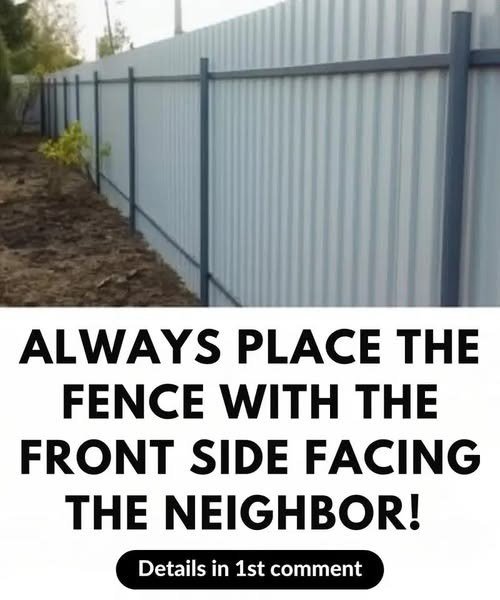
Fences seem simple until they are not.
At the planning stage, most homeowners think in practical terms first: privacy, property lines, security, pets, children, maybe noise. Those are the obvious reasons a fence exists. But what the source article argues is that one small design choice can carry a surprising amount of weight: the finished or more attractive side of the fence should face outward toward the neighbor.
At first, that sounds like etiquette masquerading as construction advice. In reality, it sits at the intersection of courtesy, regulation, and property presentation. The article frames it not as an arbitrary custom, but as a principle that can affect neighbor relations, compliance with local rules, and even how the property is perceived from the outside.
That is what makes the issue more interesting than it appears. The direction a fence faces becomes a quiet statement about how a person understands shared space.
The Article’s Core Argument: A Fence Divides Space, Not Respect
One of the strongest ideas in the source is that a fence should not create unnecessary emotional division just because it creates a physical boundary. It says that showing the polished side to the neighbor signals care for their view and experience, while turning the rail-and-post side outward can read as careless or rude. The article goes so far as to say this choice may help prevent resentment and reduce the chance of long-running disputes.
That framing is revealing.
A fence is often thought of as a declaration of ownership, but the article treats it as an expression of coexistence. The message is not just “this is my boundary.” It is also “I understand that what I build affects someone else’s daily view.” That is why the choice feels symbolic. A finished side outward communicates consideration. An unfinished side outward can feel like a signal that only one side of the boundary matters.
Whether every neighbor will interpret it that strongly is another question. But as a principle of low-conflict living, it makes sense. Shared edges tend to carry more emotional charge than people expect.
Courtesy Is Only Half the Story
The article becomes more concrete when it moves from neighborliness to rules.
It says many municipalities and homeowner associations require the finished side of the fence to face outward, partly for community appearance and partly to reduce conflict. It also warns that ignoring those standards can lead to complaints, fines, or even orders to modify or rebuild the fence.
That matters because it shifts the issue from preference to potential liability.
A homeowner might think fence orientation is a matter of taste, only to discover later that it falls under local code or neighborhood covenant language. In that sense, the article’s advice is really a warning about invisible costs. A fence may be structurally sound and still become a problem if it is installed in a way that violates outward-facing standards.
The practical lesson is straightforward: what looks like a cosmetic decision may actually be part of compliance.
Why Appearance Still Matters
The source also links fence orientation to curb appeal and perceived property value, especially when the fence is visible from the street. Its reasoning is simple: the finished side looks neat and intentional, while the exposed rails and posts can make a property appear unfinished or neglected.
That argument is not hard to understand.
People form impressions quickly, and exterior presentation shapes those impressions whether homeowners like it or not. A fence is not just a boundary object. It becomes part of the visual identity of the house. If the outward-facing side looks rougher, more industrial, or more temporary, that visual tone can affect how the entire property feels.
This is where the article’s logic broadens. Facing the finished side outward is not only about kindness to the neighbor. It is also about recognizing that exterior-facing surfaces help define the neighborhood’s visual standard, including your own.
The “Good Neighbor” Idea Is Really About Symmetry of Respect
One of the more useful details in the piece is its mention of double-sided or “good neighbor” fence designs. These are fences that look the same on both sides, eliminating the question of which side gets the better view. The article says they may cost more initially, but can offer long-term peace and visual balance.
That recommendation is telling, because it reveals the underlying value the article is defending: symmetry of respect.
If a standard fence forces a choice, the article says the neighbor should get the better-facing side. If a homeowner wants to avoid the hierarchy altogether, the “good neighbor” design solves the problem by making both views equally finished.
That is probably the most elegant solution in the whole piece. It turns a potential social friction point into a neutral design decision.
The Deeper Point Is About How People Handle Shared Boundaries
The source briefly describes the practice as a widely recognized norm in many places and connects it to empathy and community-minded ownership. That may sound lofty for an article about fences, but it points to something real.
Most property disputes are not actually about wood, wire, or inches. They are about interpretation. Was this done respectfully? Was I consulted? Was my side treated like an afterthought? Shared boundaries become emotional because they sit at the point where private control meets public consequence.
That is why the fence-facing question resonates beyond construction. It becomes a test case for how people behave when they are free to prioritize themselves but still visible to others.
The Best Advice in the Article Is the Least Dramatic
The piece closes with practical steps: check local codes, review neighborhood rules, talk to neighbors before building, and maintain the fence properly over time.
That is the most grounded part of the article.
In the end, the fence issue is not complicated because the principle is hard to understand. It becomes complicated only when people skip the quiet steps that prevent conflict: research, communication, and a little foresight. The article’s strongest message is not really “always do this one thing.” It is “build with awareness that your property decisions affect other people too.”
That is what gives the advice its staying power.
A Small Choice That Reveals a Larger Attitude
What the article ultimately argues is that the finished side of a fence should face the neighbor because it supports goodwill, satisfies many local standards, improves outward appearance, and reflects responsible ownership.
Taken literally, it is a rule of thumb for fence installation. Taken more broadly, it is a rule about how to live next to other people without turning every boundary into a contest.
A fence may separate two properties, but it also forces one basic question: when you build at the edge of your space, do you build as though the other side matters?
The source’s answer is clear.
You should.