Mack O'reilly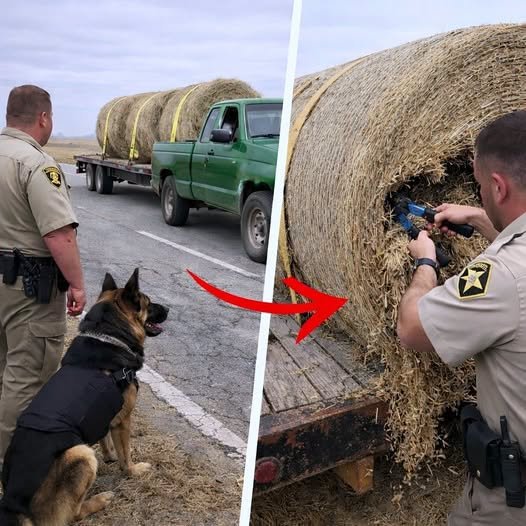
At first, nothing about the truck looked unusual.
It was moving along the highway like hundreds of other vehicles that morning, carrying what appeared to be an ordinary load of hay bales. To most drivers passing by, it would have looked like farm work, animal feed, or a routine delivery headed somewhere outside town.
There was no dramatic chase. No flashing danger sign. No obvious reason for anyone to stare twice.
But patrol work often begins with small details.
A vehicle that drifts slightly. A driver who answers too quickly. A cargo load that looks ordinary but feels out of place. A route that does not match the story. A nervous glance toward the rear of the truck.
And sometimes, the detail that changes everything does not come from the officer at all.
It comes from the dog.
A Routine Stop That Slowly Became Something Else
The deputy had not expected the stop to become memorable.
Highway stops usually begin the same way: lights, shoulder, engine off, window down, license and registration. Most end with a warning, a citation, or a brief conversation before everyone continues their day.
The driver seemed cooperative at first, but there was a tension in the air that did not quite match the situation. His hands moved too carefully. His answers came with just enough hesitation to be noticed. He seemed more concerned with the cargo than with the deputy standing beside him.
In the back, stacked high and tight, were hay bales.
They were dusty, sun-colored, and ordinary-looking. The kind of load nobody would normally inspect closely unless something about the scene demanded it.
Then the K9 reacted.
Not a lazy sniff. Not mild curiosity. A sharp, focused alert.
The dog moved toward the rear of the truck and barked again, more insistently this time, fixing attention on the bales as if something inside them did not belong.
That was the moment the stop changed.
Why a K9 Alert Carries Weight
A trained police dog does not react the way a household pet does.
K9s are trained to identify specific scents, ignore distractions, and communicate when they detect something important. Their signals can vary depending on training — sitting, scratching, staring, barking, or freezing in place — but the purpose is the same: tell the handler that something needs attention.
That does not mean every alert instantly reveals a crime. It means the situation deserves a closer look.
In this case, the dog’s focus was not on the cab, not on the tires, not on the driver.
It was on the hay.
And that made the load impossible to ignore.
The deputy circled the truck, watching the dog’s behavior and the driver’s reaction. The driver’s calm began to crack. Small changes in posture can say a lot during a stop: shoulders tightening, breathing changing, eyes following every movement.
The hay bales had become the center of the investigation.
The Bales Looked Normal — Until They Didn’t
Hay is a clever hiding place because it is messy by nature.
It sheds. It smells strong. It fills space. It makes visual inspection difficult. A bale can look uneven without seeming suspicious. Dust and straw can hide seams, cuts, wrapping, or weight differences.
To an untrained eye, one bale looks like another.
But the K9 was not judging by appearance.
The dog kept alerting near a specific section of the load. That gave the deputy a starting point. Instead of pulling apart the entire truck at random, attention narrowed to the bales that had triggered the strongest reaction.
When one of them was cut open, the scene shifted from suspicion to discovery.
What had looked like a simple farm load was no longer simple.
Inside, hidden beneath the ordinary exterior, was something the hay had been used to conceal.
The Power of Ordinary Cover
Stories like this capture attention because the hiding place feels so plain.
People expect illegal activity to look dramatic. A suspicious vehicle. A secret compartment. A nervous driver. A dark road. But in real life, concealment often works best when it looks boring.
A stack of hay bales does not invite attention. Neither does a load of produce, construction material, furniture, or sealed boxes. The more normal something looks, the less likely people are to question it.
That is why smugglers and criminals often rely on everyday objects.
The goal is not to look invisible. It is to look forgettable.
And for a while, that can work.
A driver can pass other cars, gas stations, toll booths, and roadside cameras without anyone seeing anything more than a truck carrying hay.
Until one trained nose notices what human eyes missed.
The Driver’s Story Began to Fall Apart
Once the first bale was opened, the driver’s explanation became harder to believe.
A person transporting normal cargo can usually explain where it came from, where it is going, who owns it, and why it is being moved. The details do not need to be perfect, but they usually make sense.
When the cargo hides something else, those details often begin to break down.
The route sounds vague. The destination is unclear. The ownership is shifted to someone else. The driver claims not to know what was loaded. Every answer creates a new question.
That is when a simple stop becomes an investigation.
The deputy was no longer dealing with a minor traffic issue. The truck, the cargo, the driver, and the dog’s alert all pointed toward a much larger problem.
Why These Discoveries Matter Beyond One Stop
It is easy to see a story like this as just a dramatic roadside moment.
But highway interdiction can reveal how larger networks operate. Major routes are often used to move illegal goods across regions because highways offer speed, anonymity, and constant traffic. A vehicle can blend into the flow if it looks ordinary enough.
That is why patrol officers pay attention to patterns.
Where is the vehicle coming from? Where is it headed? Does the cargo match the route? Does the driver’s story match the paperwork? Is the behavior consistent with a routine delivery?
No single detail proves everything. But when details stack together, they create a picture.
In this case, the K9 provided the piece that turned suspicion into action.
The Dog Became the Difference
Without the K9, the truck might have continued down the highway.
The bales may have looked too ordinary to search deeply. The driver may have seemed nervous but not enough to prove anything. The stop may have ended as just another roadside encounter.
That is what makes the dog’s reaction so important.
A trained K9 can detect what people cannot see. It can cut through packaging, camouflage, and distraction. It does not care how convincing the cargo looks. It follows scent.
And sometimes, that is enough to expose an entire hidden plan.
The deputy may have made the stop, but the K9 changed the direction of the case.
A Reminder Hidden in Plain Sight
The most unsettling part of the story is not the hay itself.
It is the idea that something so ordinary could be used to hide something serious.
A truck full of bales belongs on a highway. It does not look threatening. It does not make people move away. It does not create panic. It blends into rural roads, delivery routes, and everyday traffic.
That is exactly why it worked — until it didn’t.
The K9’s barking turned a forgettable load into evidence. The deputy’s decision to trust the alert turned a routine stop into a discovery. And the hay bales, once opened, told a story the driver could no longer explain away.
Sometimes the biggest secrets are not hidden in dark rooms or locked boxes.
Sometimes they are stacked in plain sight, wrapped in dust, and waiting for the one nose that knows something is wrong.